All contacts of person initially diagnosed as asymptomatic case test negative

(Xinhua)11:10, December 01, 2020

CHONGQING, Dec. 1 (Xinhua) — All of the nucleic acid test results were negative for contacts of the traveler from southwest Chinas Chongqing, who was initially diagnosed as an asymptomatic COVID-19 case upon arriving in the Republic of Korea (ROK), the health authorities of Chongqing said Monday.

The city has traced over 8,000 people who had contact with the traveler or with his close contacts, all of whom have tested negative in nucleic acid screenings, said the headquarters of COVID-19 prevention and control in Chongqings high-tech industrial development zone.

The ROK national is an employee of a local company and had been in the municipality since Feb. 1. He traveled to the ROK Friday and was later diagnosed as an asymptomatic coronavirus case, according to earlier official announcements.

The company said the second nucleic acid test of the traveler in the ROK turned out to be negative.

Environmental samples from the company and the hotel, which had accommodated the ROK national, also tested negative for the virus.

The municipality has allowed the company and the hotels, which had been temporarily shut down due to the incident, to resume operation.

China’s Guangxi helps Southeast Asian countries reduce poverty

(Peoples Daily Online)17:18, November 30, 2020

Photo shows a bridge in a village of Vientiane, Laos. The bridge was built under a poverty alleviation project carried out by Guangxi Zhuang Autonomous Region in southern China. Photo courtesy of the poverty alleviation work office from Guangxi Zhuang Autonomous Region

While lifting itself out of poverty, China’s southern autonomous region Guangxi has also shared poverty reduction experience with neighboring ASEAN countries, such as Laos and Thailand, Xinhua reported.

In Vientiane, Laos, projects from China such as paddy fields, modern agriculture and poverty alleviation through tourism have benefited local farmers.

In September 2017, Guangxi kicked off a poverty reduction program in Laos, aiming to improve local infrastructure and public services through giving technological support. In recent years, such cooperation is not rare between China and Laos.

A farmer from Vientiane, who has travelled to China twice in order to gain knowledge in poverty alleviation, said he is using agricultural technologies he learned from China in order to boost local industries, such as weaving, cow breeding and corn growing.

Thailand, another beneficiary of China’s poverty reduction concept, is currently accelerating poverty alleviation through improving employment services and helping rural areas enhance their own capacity for poverty alleviation, according to Prof. Rajendra P. Shrestha from the Asian Institute of Technology, Thailand.

HKSAR chief executive highlights Hong Kongs advantages in BR cooperation

(Xinhua)17:18, November 30, 2020

HONG KONG, Nov. 30 (Xinhua) — Chief Executive of Chinas Hong Kong Special Administrative Region (HKSAR) Carrie Lam Monday highlighted Hong Kongs advantages in participating in the Belt and Road cooperation, including its status as a financial center and close ties with the mainland.

For those who are looking to grasp the opportunities presented by the Belt and Road, I would say that Hong Kong is your ideal partner given our unique strengths, Lam said when addressing the Belt and Road Summit.

Organized by the HKSAR government and the Hong Kong Trade Development Council, the landmark forum, running from Monday to Tuesday, is being held online for the first time due to the COVID-19 pandemic.

Hong Kongs growing integration into the Guangdong-Hong Kong-Macao Greater Bay Area is a far-reaching advantage, Lam said, stressing that the Greater Bay Area, with a population of some 72 million, presents the untapped potential for sustainable, inclusive and innovative businesses.

Lam said Hong Kong, one of the worlds leading financial centers, can also contribute to sound and sustainable financing and partnership along the Belt and Road. Over the past few years, Hong Kong has been taking leading steps in promoting green development and investment in sustainable assets.

Hong Kong also boasts multilingual, multi-talented financial and related services professionals, the rule of law, an open and efficient market, the free flow of capital, information and people, and a simple and low tax regime, Lam said.

The summit, the fifth since 2016, attracted thousands of government officials, business leaders, industry experts and senior institutional players from across the world this year.

Life-saving devices come to the rescue

(Chinadaily.com.cn)10:17, November 30, 2020

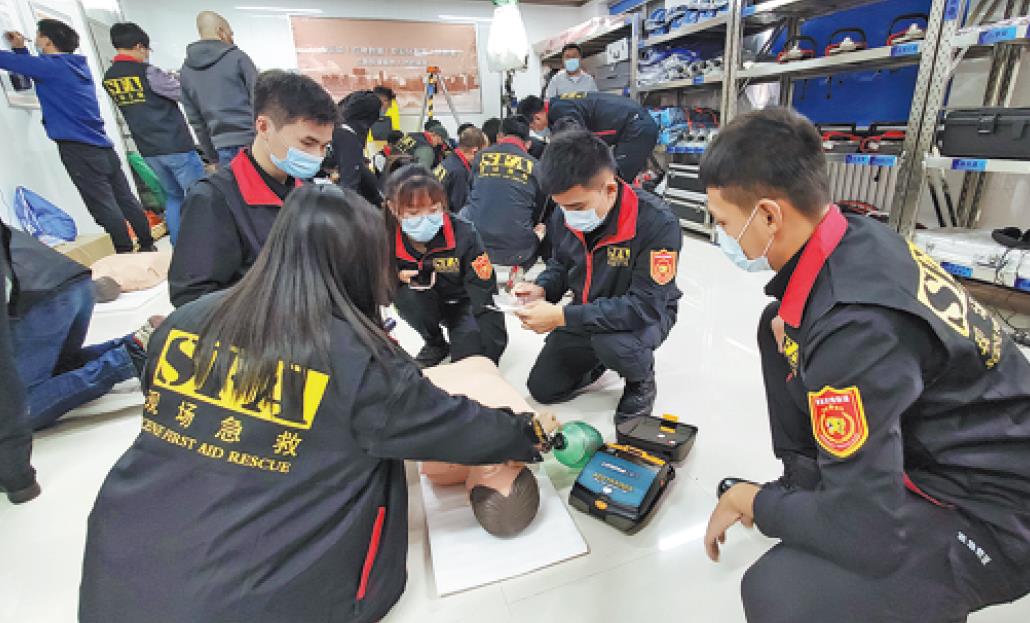
Volunteers in Beijing learn first aid, including how to use an automated external defibrillator and perform cardiopulmonary resuscitation.(Photo provided to China Daily)

More machines deployed in key areas

It takes just four minutes for brain cells to be permanently damaged due to a severe lack of oxygen in cases of sudden cardiac arrest where professional help is not immediately available.

If medical workers do not arrive at the scene of such emergencies within 10 minutes, the chances of a victim surviving are minimal.

In September, a 45-year-old man fell unconscious at Huoying station on Line 13 of the Beijing Subway. He died later in the hospital, despite attempts by two passengers to revive him by using cardiopulmonary resuscitation, or CPR.

However, if an automated external defibrillator, or AED, had been available at the scene, the mans chances of survival would have been greatly improved.

An AED can recognize an abnormal heart rhythm and quickly correct it through an electric shock.

The devices are viewed in medical circles as a more efficient and effective method of saving lives in emergencies than using CPR. After a brief training period, people with no medical knowledge can master the basic skills needed to use an AED.

In May last year, a student at Tsinghua University in Beijing fainted in a dormitory after experiencing head sweats. His hands also involuntarily formed fists. Several students began to perform CPR, artificial respiration and also used a newly installed AED to help the stricken freshman.

After two electric shocks were administered, the students heart beat was restored and he was sent to the hospital for further treatment.

An emergency doctor from the hospital who attended the scene said it was highly likely the student would have died had not a series of the correct first aid measures been applied, along with the AED.

In 2010, a study published in the Journal of the American College of Cardiology said the availability of an AED in a community nearly doubles the chances of survival in cases of out-of-hospital cardiac arrest.

The research, which focused on assessing the effectiveness of AED use, found that some 38 percent of people who experienced cardiac arrest could survive if they received an electric shock from an AED before the arrival of an emergency medical team.

Pei Zheng, a staff member from Tsinghua Universitys Policy Research Office, said it was really cool that AEDs were available at the institution, as the incident involving the freshman occurred just two months after they were installed.

Its so good that we have these life-saving machines on campus, otherwise we would have heard tragic news, she said.

In March last year, the university received a donation of 341 AEDs from alumnus Xu Hangyu. The devices have been installed around the campus in stages.

It is the first educational institution in China to promote the Public Electric Defibrillation Program, which aims to safeguard students health by providing such devices.

【1】【2】

Chinese mainland reports 3 new domestically transmitted COVID-19 cases

(Xinhua)13:39, November 30, 2020

BEIJING, Nov. 30 (Xinhua) — Chinas National Health Commission said Monday that it received reports of 18 newly confirmed COVID-19 cases on the Chinese mainland Sunday, including three domestically transmitted cases and 15 imported ones.

All the domestically transmitted cases were reported in Inner Mongolia, the commission said in its daily report.

No new suspected cases or new deaths related to COVID-19 were reported Sunday, the commission said.

A total of 21 COVID-19 patients were newly discharged from hospitals after recovery on the Chinese mainland on Sunday.

By the end of Sunday, a total of 3,858 imported cases had been reported on the mainland. Among them, 3,609 had been discharged from hospitals following recovery, and 249 remained hospitalized. No deaths had been reported among the imported cases.

The total number of confirmed COVID-19 cases on the mainland reached 86,530 by Sunday, including 277 patients still receiving treatment, seven of whom were in severe conditions.

A total of 81,619 patients had been discharged following recovery on the mainland, and 4,634 had died of the virus, according to the commission.

There were seven suspected COVID-19 cases on the mainland on Sunday, and 7,174 close contacts remained under medical observation.

Sunday saw 17 newly reported asymptomatic cases, 14 of whom were arriving from outside the mainland. On the same day, two asymptomatic cases were re-categorized as confirmed cases.

A total of 281 asymptomatic cases were under medical observation, including 274 arriving from outside the mainland.

By the end of Sunday, 6,238 confirmed COVID-19 cases, including 109 deaths, had been reported in Hong Kong Special Administrative Region (SAR), 46 cases in Macao SAR, and 651 cases, including seven deaths, in Taiwan.

A total of 5,340 COVID-19 patients in Hong Kong SAR had been discharged from hospitals following recovery, 46 in Macao SAR, and 565 in Taiwan.

Hong Kong suspends import of poultry products from areas in Japan, France

(Xinhua)09:36, January 15, 2021

HONG KONG, Jan. 14 (Xinhua) — Hong Kongs food safety authority decided on Thursday to suspend the import of poultry meat and products from Kagoshima Prefecture in Japan, and Canton of Armagnac-T茅nar猫ze in France due to the bird flu outbreaks in these regions.

The Center for Food Safety (CFS) of the Hong Kong Special Administrative Region (HKSAR) governments Food and Environmental Hygiene Department has instructed the trade to suspend the import of poultry meat and products, including poultry eggs, from these areas with immediate effect to protect public health in Hong Kong.

The CFS said this was in view of notifications from the Ministry of Agriculture, Forestry and Fisheries of Japan about an outbreak of highly pathogenic H5 avian influenza in Kagoshima Prefecture, and from the World Organization for Animal Health (OIE) about an outbreak of low pathogenic H5N3 avian influenza in Canton of Armagnac-T茅nar猫ze.

The CFS has contacted the Japanese and French authorities over the issues and will closely monitor information issued by the OIE and the relevant authorities on the avian influenza outbreaks. Appropriate action will be taken in response to the development of the situation, a CFS spokesman said.

Facts Figures Chinas foreign trade in 2020

(Xinhua)09:43, January 15, 2021

BEIJING, Jan. 14 (Xinhua) — China emerged from the global economic and trade challenges in 2020 as the worlds only major economy to have registered positive growth in foreign trade in goods.

The following are some facts and figures on Chinas foreign trade volume and structure.

— Chinas total imports and exports of goods expanded 1.9 percent year on year to 32.16 trillion yuan (about 4.97 trillion U.S. dollars) in 2020, hitting a record high despite a worldwide slump in shipments.

— Exports rose 4 percent, while imports went down 0.7 percent.

— Chinas foreign trade with the other 14 members of the Regional Comprehensive Economic Partnership amounted to 10.2 trillion yuan, up 3.5 percent year on year and accounting for 31.7 percent of its total imports and exports during the period.

— Chinas foreign trade with countries along the Belt and Road totaled 9.37 trillion yuan, up 1 percent year on year.

— ASEAN was Chinas biggest trading partner, with the combined trade volume with the 10 member states rising 7 percent year on year to 4.74 trillion yuan.

— Other major trading partners include the European Union, the United States, Japan and the Republic of Korea, with the respective trade volumes up 5.3 percent, 8.8 percent, 1.2 percent and 0.7 percent.

— Imports and exports by private businesses came in at 14.98 trillion yuan, up 11.1 percent year on year and accounting for 46.6 percent of Chinas foreign trade during the period.

China to impose anti-dumping duties on meta-Cresol imports

(Xinhua)09:49, January 15, 2021

BEIJING, Jan. 14 (Xinhua) — China will initiate anti-dumping measures against imported meta-Cresol from the United States, the European Union (EU), the United Kingdom (UK) and Japan, the Ministry of Commerce said Thursday.

Chinas domestic industry has suffered substantial damage due to the dumping of such products by the United States, the EU, the UK and Japan, the ministry said in a final ruling based on an anti-dumping investigation launched in July 2019.

Starting from Friday, duties will be collected at rates ranging from 27.9 percent to 131.7 percent for a five-year period, according to the ministry.

The meta-Cresol is widely used in the fields of medicine, pesticides and antioxidants, among others.

BFA report calls for strengthened free trade ties among Asian economies

(Xinhua)11:09, January 15, 2021

BEIJING, Jan. 15 (Xinhua) — The Boao Forum for Asia (BFA) called for connecting and integrating the free trade agreements (FTA) among major Asian economies to expand FTA coverage and develop a new blueprint for Asian economic integration, according to a report released on Thursday by the BFA.

Asian economies should enhance study on FTA rules with a focus on trade in essential public goods, unimpeded supply chains and digital trade, among others, said the report.

The report proposed to beef up the utilization rate of Asian FTAs to give a stronger sense of fulfillment to businesses and people in the region, promote reform through opening up and align domestic policies with the FTAs.

Asian economies also need to accelerate the building of high-standard and future-oriented Asian free trade areas in light of national conditions of countries and provide Asias solutions to the reform of the multilateral trading system, said the report.

In the face of the COVID-19 pandemic, Asian countries need to work together and actively promote regional cooperation arrangements such as FTAs, so as to inject new impetus into regional economic growth, said BFA Secretary General Li Baodong.

A number of bilateral and multilateral economic and trade agreements reached recently have become bright spots of the world amid the pandemic, said Zhou Xiaochuan, vice chairman of the BFA.

Efforts should be made to promote Asian economies to participate in FTAs at a higher level and with wider coverage to facilitate the reform of the World Trade Organization and the reshaping of multilateral trading rules, Zhou said.

E-commerce boosts income of Chinese farmers ministry

(Xinhua)10:22, January 14, 2021

BEIJING, Jan. 13 (Xinhua) — E-commerce has helped bump up the income of Chinese farmers, contributing to the countrys efforts on rural vitalization, the Ministry of Agriculture and Rural Affairs said Wednesday.

In 2019, rural online retail sales neared 400 billion yuan (about 61.9 billion U.S. dollars), said ministry official Zeng Yande at a press conference.

Quite a few farmers in China have turned to short videos or live streaming to sell their homegrown produce, and they managed to get high prices, Zeng said.

Conditions for rural e-commerce development, including communication facilities and logistics, have witnessed continued improvements in recent years, with 4G network coverage for 98 percent of villages in the country, according to the ministry.

More than 10 million people have engaged in entrepreneurship and innovation in rural areas so far, serving as an important force supporting the development of the rural e-commerce sector.

Over the past three years, China has implemented its rural vitalization strategy. Farmers have seen continuous growth in their incomes and a narrowed income gap relative to urban residents.

The country detailed plans to fully promote the strategy of rural vitalization in the Chinese leaderships proposals for formulating the 14th Five-Year Plan (2021-2025) for National Economic and Social Development and the Long-Range Objectives Through the Year 2035.

Under this development blueprint, China will push the development of industries with distinctive rural characteristics, cultivate new industries and modes of business, and encourage entrepreneurship and innovation in rural areas.